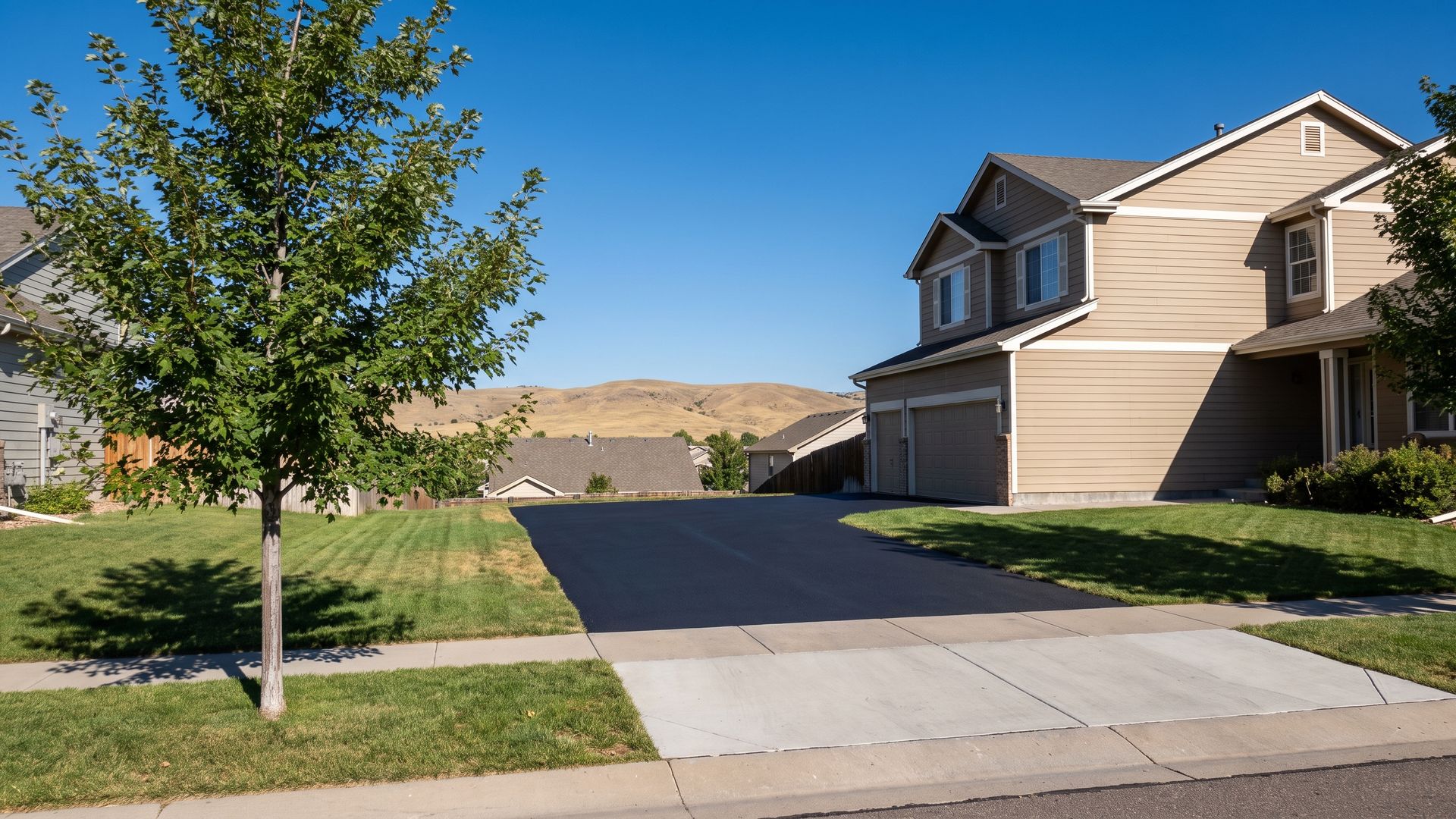
Asphalt Sealcoating in Loveland, Colorado
Loveland was founded in 1877 along the Colorado Central Railroad and named for the railroad's president, William A. H. Loveland. It sits at the base of the foothills just east of the mouth of Big Thompson Canyon, and US 34 runs through it as Eisenhower Boulevard, splitting the city north and south. The 2020 census counted 76,378 residents, up from 66,859 in 2010, and the 2025 estimate is 81,387. The average Loveland home was built in 1990, a year earlier than the Fort Collins average, so much of the residential asphalt here has been through several seal cycles already, or should have been.
The city has its own NOAA normals station, Loveland 2 N, and its nights run colder than the CSU campus reading. NOAA's 1991-2020 normals there list 181.1 freezing nights a year and 17.8 days that never thaw, which leaves about 163 freeze-thaw days, against about 131 on campus. The median last spring freeze is May 10 and the median first fall freeze September 28, a shorter window than Fort Collins gets. That is a reason to book driveway sealcoating for June or July rather than wait for fall.
free quotes, fast response, local pros.
Free quote
Loveland's street standards and river history
Loveland builds its streets to the same Larimer County Urban Area Street Standards as Fort Collins; the current version took effect August 1, 2021, after adoption by both cities and the county. Under those standards a permit is required before any driveway access is built or rebuilt, the approach between the street and the right-of-way line is concrete, and a residential approach runs 12 to 24 feet wide, or up to 30 feet for a three-car garage. For an owner, that means the asphalt drive ends at the right-of-way line. Sealing, crack filling and patching stay on the private side, and anything that touches the curb goes through the city first.
Water history shapes the west side of town. The Big Thompson flood of 1976 killed 144 people in the canyon above Loveland, and the flood of September 12, 2013 caused two more deaths in Larimer County. The lesson for a driveway is smaller in scale but similar in kind: water that is not steered off pavement finds its way under it. Downspouts that empty onto a drive, a low spot at the garage slab and an edge where the lawn sits above the asphalt are the places to fix before paying for sealer, and crack filling closes the other way in.
See Loveland, CO on Google Maps — we cover the whole area from Fort Collins.
Asphalt Sealcoating Services Available in Loveland
Every service described on this site is available in Loveland as well:
See the full pricing guide for typical ranges.
Loveland FAQs
Why does the Loveland station record more freezing nights than the campus?
The two stations sit in different settings. The Fort Collins station is on the CSU campus in the middle of a city of about 170,000 people, while Loveland 2 N is a separate station north of Loveland at 1,548 meters. Its normals show 181.1 nights a year at or below 32 degrees against 146.8 on campus, and a freeze-free median from May 10 to September 28. For a driveway, the practical result is more freeze-thaw crossings each year, which makes fall crack filling more valuable here, not less.
Does widening a Loveland driveway need a permit?
At the street end, yes. The county street standards Loveland uses require a permit before any access is built or rebuilt, cap residential approaches at 24 feet, or 30 for a three-car garage, and allow driveways on no more than half of a lot's street frontage except on cul-de-sacs and flag lots. Widening the asphalt behind the right-of-way line is private work, but a wider curb cut is not. Check with the City of Loveland before a contractor saws the curb.
When should a Loveland driveway be sealed?
In midsummer. With a median last freeze of May 10 and a median first freeze of September 28 at Loveland 2 N, the frost-free window is shorter than in Fort Collins, and SealMaster's guidance of 50 degrees and rising for 24 hours, no rain in that time and a full day before traffic narrows it further. June, July and August give the most reliable conditions, and a morning start leaves time for the coat to set before an afternoon thunderstorm.
Get Your Free Loveland Quote
Free quote