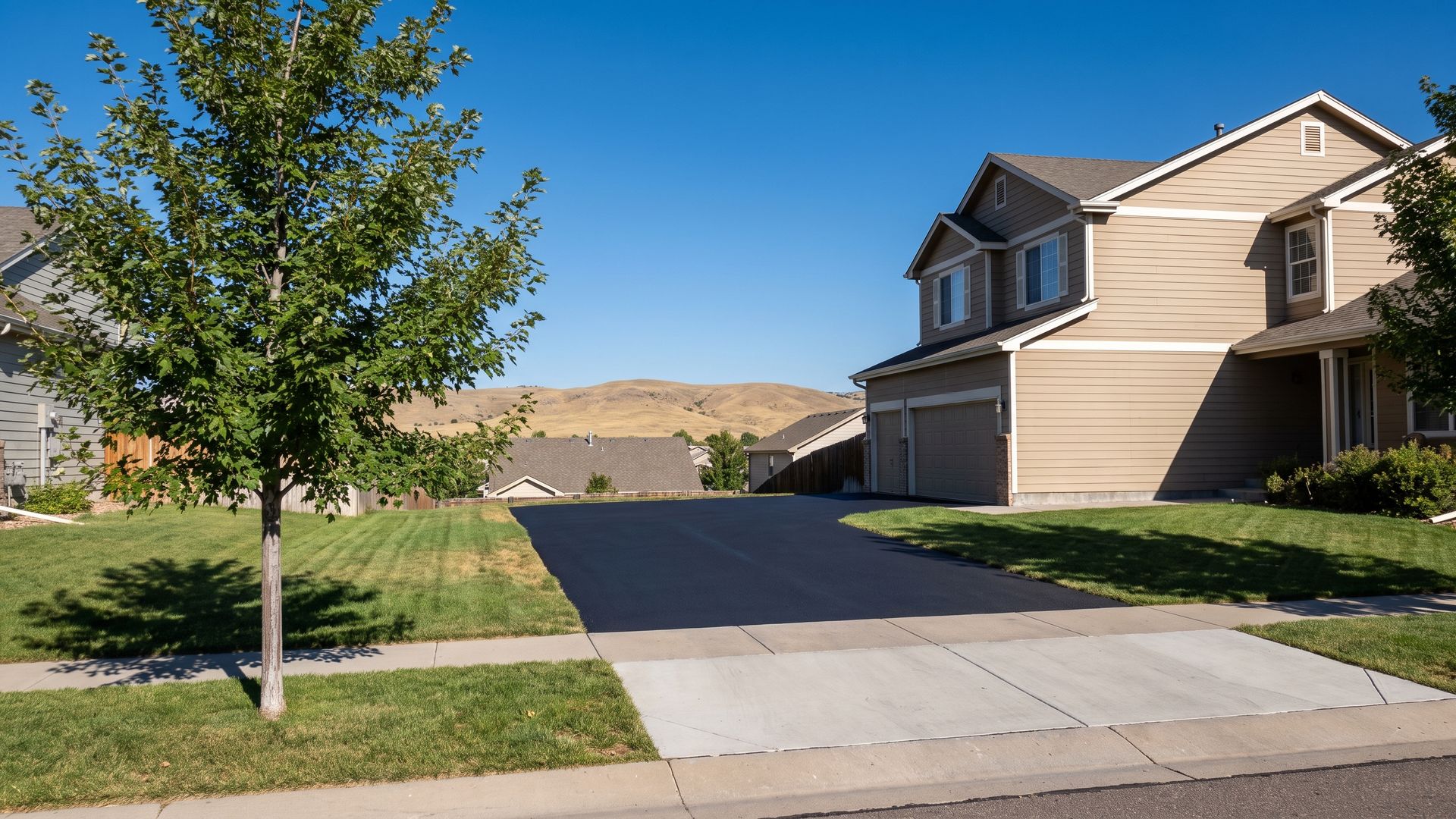
Two soil series tell most of the story under local driveways. The Fort Collins series is named for the city, and its typical profile was described about one block north of LaPorte Avenue on North Shields Street: a well-drained loam formed in wind-blown sediment and alluvium on terraces and fans, with 18 to 35 percent clay in the subsoil and lime starting 8 to 20 inches down. The Nunn series, whose type location is also in Larimer County, is a different ground altogether, with 35 to 50 percent clay, smectitic mineralogy and moderately slow or slow permeability. The Colorado Geological Survey names montmorillonite as the clay generally responsible for swelling in the state and lists cracked driveways among the results. Water that reaches a clay subgrade through an open crack does not drain away quickly.
The freeze-thaw count is not spread evenly through the year. On the station's monthly normals, December and January each bring about 25 days that cross the freezing line, November and February about 22, and March still about 20, while May has barely one. Winter afternoons stay mild enough to keep the cycle going: in an average December through February, 61 afternoons reach 40 degrees and about 30 reach 50, against 84 nights that drop to freezing. On about 33 winter days the campus has at least an inch of snow on the ground. Sun on packed snow at midday, running water by afternoon and ice in the cracks by morning is the ordinary winter week here.
City streets run on a schedule a homeowner can learn from. The Street Maintenance Program, paid for by a quarter-cent street maintenance tax that voters extended in November 2024 for 20 years through 2045, chooses treatments from detailed inspections and pavement condition scores and lists crack seal, slurry seal, chip seal and overlays among the work it does to extend road life. Residential streets are swept four times a year and major streets every two weeks. Snow is handled in four priorities, with more than 1,050 lane miles of arterials, collectors and school routes ahead of neighborhood streets, which are plowed only when blocked or in an emergency. The city does not clear driveways, and owners have 24 hours after a snowfall to clear the sidewalk.
The strip between a driveway and the street follows the Larimer County Urban Area Street Standards, which Fort Collins, Loveland and Larimer County adopted in a version effective August 1, 2021. They call for Portland cement concrete from the edge of the street pavement to the edge of the right-of-way, so on streets built or rebuilt to that standard the asphalt drive ends where a concrete approach begins. Residential approaches must be 12 to 24 feet wide, or up to 30 feet for a three-car garage, and the drive may be no steeper than 8 percent within 20 feet of the gutter flowline. A permit comes before any access is built or rebuilt, and in the city, work on an approach needs a Sidewalk and Drive Approach Permit and a contractor holding the Right-of-Way Contractor License.
Rain and snowmelt that leave a driveway do not go to a treatment plant. Fort Collins Utilities, which has operated a stormwater utility since 1980, says most stormwater flows through storm sewers to local creeks and the Cache la Poudre River untreated. The monthly stormwater charge is built from lot size and a runoff factor between 0.25 and 0.95 set by the share of the lot that is impervious, with 0.4 listed as typical for a house. No Colorado state, county or city restriction on coal-tar sealer appears on the national ban list kept by Coal Tar Free America, and the USGS says coal-tar sealcoat is used more on the eastern side of the Continental Divide, which includes Fort Collins, and contains roughly a thousand times as much PAH as asphalt-based sealcoat. Which product is in a bid is worth asking.
Frost reaches deep enough to matter. The city's building code sets a 30-inch frost depth for design, and the county street standards require swell testing whenever soil samples show probable expansion above 2 percent. Newer pavement is concentrated in the surrounding towns: the average home in Loveland dates to 1990, in Wellington to 2007, in Windsor to 2008 and in Timnath to 2015, where the population went from 625 in 2010 to 6,487 in 2020. Owner occupancy in Fort Collins itself is 51.6 percent, lower than in any of those four towns, which run from 62.2 percent in Loveland to 82.6 percent in Timnath.